
Drainage Solutions in Acworth and Across Georgia
Complete drainage solutions designed to properly manage water and protect your property. From French drains, catch basins, downspout extensions, and dry creek beds to grading and erosion control, we create effective drainage systems that move water where it belongs and help prevent standing water, washouts, and property damage.
Why Georgia yards hold water
Grading and erosion work in Georgia follows the Manual for Erosion and Sediment Control, the book everyone calls the Green Book, published by the Georgia Soil and Water Conservation Commission. It is the standard the counties inspect against.
Sandy soil lets water through. Red clay does not. It holds the water at the surface and turns the low spot in the back yard into a pond that is still there three days after the rain quit. That is not a lawn problem, and no amount of seed, sod or aeration will fix it. It is a grading and drainage problem.
New construction makes it worse. Grading equipment packs the clay down hard, the topsoil layer that goes back on top is thin, and the downspouts dump four inches from the foundation. The first heavy spring storm shows you exactly where the water wants to go, usually across the patio and up against the house.
What standing water actually costs
The foundation
Water that sits against a footing or a basement wall eventually gets in. You see it as a white chalky bloom on block, a damp line on finished drywall, or a crawlspace that smells wet in July. Moving roof water away from the house is the cheapest foundation work anybody ever pays for.
The lawn
Turf drowns in standing water. Bermuda goes out first because it wants sun and drainage, fescue thins and rots at the crown, and what fills the bare spot is moss, nutsedge and mosquitoes. People spend two seasons treating a fungus that was really a drainage issue.
The slope
On a grade the water does not sit, it runs, and it takes topsoil and mulch with it. You see it as a rut behind the bed line, exposed roots on the high side, and a fan of red silt across the driveway after every storm.
How we fix it
French drains
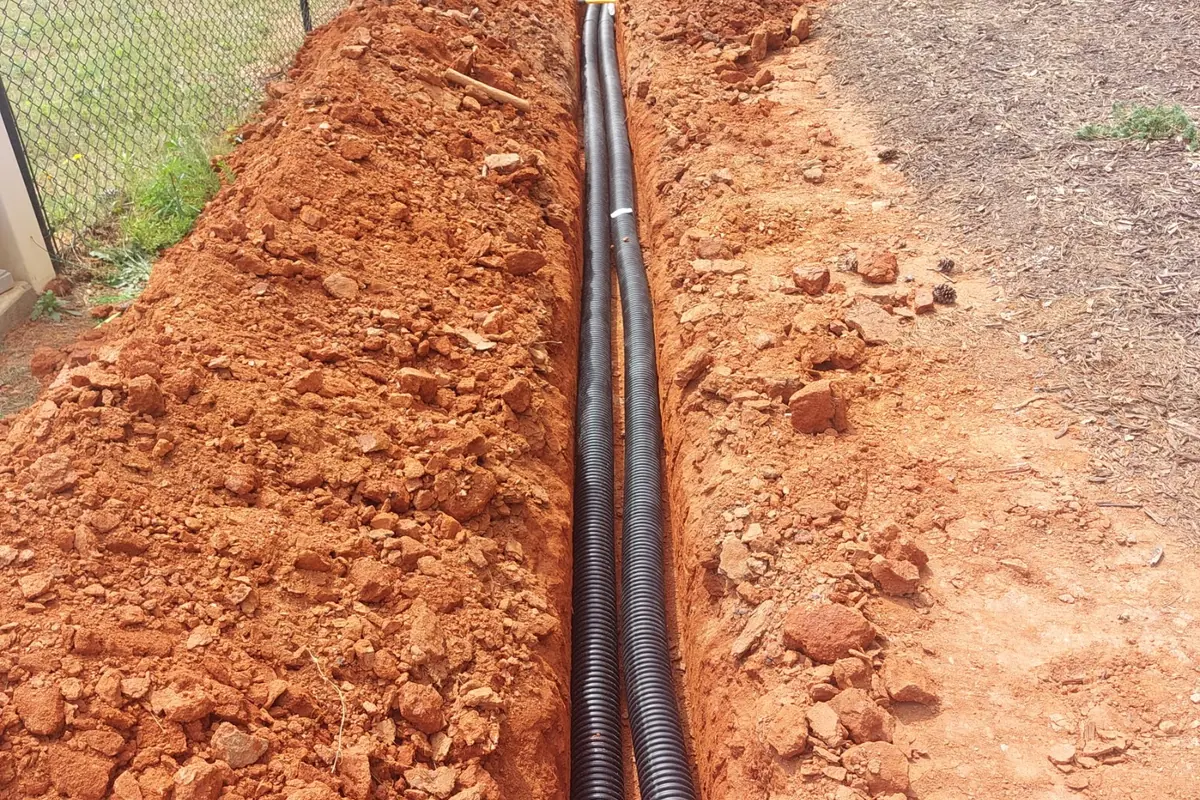
A trench, perforated pipe, filter fabric, washed stone around all of it, and a fall that actually runs downhill to daylight or to a basin. The fabric and the stone are the whole job. A pipe buried in clay with dirt packed back around it silts up and quits inside two seasons, which is why so many people tell us their last French drain stopped working.
Catch basins and solid pipe
Where the water collects in one spot, we set a basin with a grate at the low point and run solid pipe away from it. Basins want cleaning out once or twice a year, so we put them where you can reach them with a shop vac instead of somewhere that looks tidier on paper.
Downspout extensions
The cheapest fix on this page and the one most houses need. A roof sheds a serious amount of water in one storm and a splash block moves it about two feet. We tie the downspouts into buried solid pipe and carry it out to a pop-up emitter well away from the house.
Regrading
Sometimes the answer is dirt, not pipe. We cut the high ground, fill the low ground, and set a positive slope running away from the foundation toward somewhere the water can actually go. Then sod or seed goes down so the new grade holds instead of washing out on the next storm.
Dry creek beds
A stone-lined swale that carries storm water on the surface where a buried pipe is not practical. It handles volume, it does not clog, and it reads as part of the landscape instead of a repair. Sized right and set with river rock and a few boulders, it is the one piece of drainage work people are actually glad to look at.
Erosion control on slopes
Terracing, a low retaining wall, plant material with roots that hold, and stone where the water moves fastest. On a steep back yard we usually pair a wall with a drain behind it, because a block wall is only as good as the drainage behind the block.
What we look at when we walk the property
- Where the water comes in and where it can get out. Every fix needs an outlet, and the outlet is the part that decides the whole design.
- Roof area and downspout locations. Roof water is usually more than half the problem.
- Grade at the foundation, at the walks, at the patio and at the driveway apron.
- How deep the clay runs once we open a test hole. That changes the trench and the price.
- Utilities. Georgia 811 gets called before we dig, every time.
- What is downhill of you. A fix that dumps your water into the neighbor's yard is not a fix, it is a different argument.
Drainage and hardscape belong together
Half the drainage calls we get come from a patio or a wall that was built without drainage behind it. Pavers set on a base with nowhere to shed water will heave. A block wall with clay packed behind it and no drain stone takes on water pressure and starts to lean, and by the time you can see the lean it is a rebuild.
Since we build the hardscapes too, we solve both at once instead of pointing at the other contractor. One call, we do it all is not a slogan on this one; it is the reason the wall and the drain get designed together.
What We Install
Six ways to move water off a property. Most jobs use two or three of them together, because one alone rarely covers a whole yard.
French drains
Perforated pipe, filter fabric and washed stone in a trench with real fall. Built so it still runs in five years instead of silting shut in two.
Catch basins and solid pipe
Grated basins at the low points, solid pipe out to daylight. Placed where you can actually get a hand and a shop vac into them.
Downspout extensions
Roof water buried and carried away from the foundation to a pop-up emitter. The smallest job on this list and often the biggest difference.
Regrading and swales
Cut, fill and shape until the ground slopes away from the house. Sod or seed behind it so the new grade holds through spring rain.
Dry creek beds
Stone-lined surface channels for high volume runoff. They do not clog, they do not need a pipe, and they look like they belong in the yard.
Erosion control
Terraces, low walls, stone armor and root systems on slopes that keep washing out. Paired with a drain behind the wall where the grade calls for it.
What Moves the Price
Drainage pricing lives underground, so nobody can quote it honestly from a photo. Here is what the number actually turns on.
Length of run and depth
Every foot of trench is dig, stone, pipe, fabric and backfill. Depth matters more than length, because a deep trench in packed clay is slow work and it changes the machine we bring.
Where the outlet is
A yard that falls off to a wood line is straightforward. A flat lot with no daylight low point needs a longer run, a pop-up, or a dry well, and that is a different job.
Access
If a mini excavator fits through the gate, the job goes one way. If everything has to come around the house by wheelbarrow, or the trench crosses a driveway, it goes another.
Putting it back
Trenching tears up turf and beds. Sod, seed, straw and fresh mulch to make it look like nobody was there is part of the estimate, not an extra we bring up at the end.
Three Steps, No Runaround
-
We walk it after a rain if we can
Wet ground tells the truth. We follow the water from the roof to the low spot, check the grade at the foundation, and find the outlet.
-
You get the plan and the number
What we are installing, where it runs, where it lets out, and what the yard looks like when we put it back. In writing before we dig.
-
Locates, dig, install, restore
Georgia 811 marks the utilities first. Then we trench, install, backfill, and put the turf and the beds back the way we found them.
Drainage Questions We Get
Do I need a French drain or just better grading?
It depends on whether the water is sitting or running. Water that ponds in a low spot and stays there usually needs a drain and an outlet. Water that sheets across the yard toward the house is usually a grading problem, and pipe will not fix a grade that points the wrong way. A lot of properties need both, and the walk-through is where we sort out which one is doing the damage.
Will drainage work fix water in my basement or crawlspace?
Sometimes, and it is always the first thing to try. Most wet crawlspaces in North Georgia are fed by roof water and a bad grade at the foundation, and fixing those two outside solves a lot of them. If water is already coming through a wall or up through a slab, you may also need interior work or a waterproofing contractor, and we will say so instead of selling you a trench that was never going to be enough.
How long does a drainage job take?
Most residential jobs run one to three days on site once we start. Utility locates have to be called in before that and they take a few business days, so we build that into the schedule when we set the date. Rain moves us, because trenching saturated clay makes a mess and a worse result.
Will you tear up my whole yard?
We open a trench and a staging area, not the whole lawn. The trench line and the spoil pile are the visible part, and both get backfilled, tamped and covered with sod, seed or mulch before we leave. Ruts from the machine get raked out. Give the repaired strip one growing season and you will have to look for it.
Do you call for utility locates before digging?
Yes, on every job. Georgia 811 is free and it marks the public utilities, and the notice period is a few business days, which is why we schedule around it. Private lines the utility does not mark, like an irrigation main, a gas line to a grill, a septic field or invisible fence wire, we ask you about before we start.
Can you stop the erosion on a steep back yard?
Usually, yes, and it takes more than one thing. Slowing the water down matters more than moving it fast, so the fix is normally some combination of terracing, a low retaining wall with drainage behind it, stone where the flow is fastest, and plant material with roots that hold soil. We look at what is feeding the slope from above first, because armoring the bottom of a slope while the top keeps washing is money spent twice.
Free Estimates. Residential & Commercial.
Show us where the water stands and Hunter will get you a number. There is no charge to have us come look.
Licensed & Insured · 10+ Years of Trusted Service · Serving All of Georgia