
Residential Lawn Maintenance in Acworth and Across Georgia
Our residential maintenance packages offer weekly and bi-weekly service options tailored to your property, grass type, seasonal growth, and specific needs. Every scheduled visit includes a complete property maintenance service—not just mowing. This includes mowing of all grass areas, fresh and defined edge lines every visit, weed eating of all weeds throughout the property, trimming and maintaining all shrubs as needed, chemical weed treatment in applicable areas, blowing off all hard surfaces, and removal of all lawn and landscape debris. We provide complete, year-round maintenance to keep your entire property clean, healthy, and professionally maintained in every season.
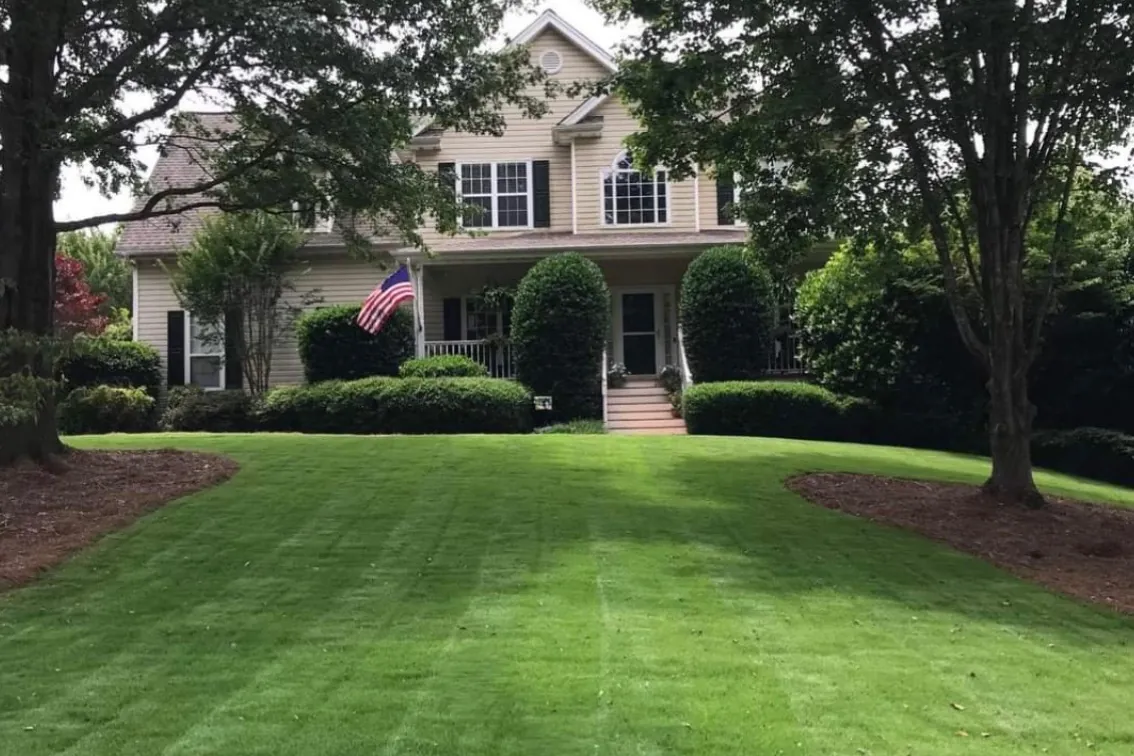
Cut for the grass you actually have
Most yards in Cobb, Cherokee and Bartow County are one of three things. UGA Extension's GeorgiaTurf program is the reference we go back to on what fits where. Bermuda and zoysia are warm season grasses that run hard from May through September and go tan and dormant once the nights get cold. Tall fescue is a cool season grass that does its best growing in spring and fall and spends July trying to survive. Same street, same weather, opposite instructions.
Bermuda wants a low, frequent cut. Take it too high and it gets stemmy and thin at the base. Fescue is the opposite. It needs to stay tall through the summer so the blades shade their own crowns and the soil underneath holds a little moisture. Every August somebody calls about a fescue lawn that went brown, and the cause is almost always the same: it got scalped down to two inches in June by a crew running one deck height across the whole neighborhood.
We set the deck for your lawn and we change it as the season turns. That is not a premium add-on. It is just the job.
What every visit includes
- Mow at the correct height for the turf type and the time of year
- Alternate the mowing pattern so the grass is not laid over the same direction every week
- Edge the driveway, walks and curb line so the border stays crisp
- Weed eat fence lines, mailboxes, foundations, trees and anything the deck cannot reach
- Prune and trim all shrubs as needed to keep the beds shaped and the growth in check
- Blow the drive, walks, porch and patio clean before we pull out
- Bag or mulch the clippings depending on growth and the condition of the lawn
- Tell you what we saw, whether that is a dry zone, a fungus spot or a sprinkler head spraying the driveway
On request we also spray the property with Roundup QuikPro to hold the weeds back in beds, along fence lines, and in cracks and joints. It is an optional add-on rather than part of the standard visit, so tell us if you want it on your property and we will work it into the schedule.
The Georgia calendar, in order
March is pollen and the first real growth. Everything is yellow, the fescue takes off, and Bermuda is still waking up. April through June is the fastest growth of the year and the time when a skipped week actually shows. July and August are drought and heat, so mowing height goes up and frequency can come down. September and October bring a second flush on the fescue lawns. November through February is leaf drop, dormancy and cleanup.
Dormant Bermuda in January is tan, and that is normal. It is not dead and it does not need to be fixed. If a company tries to sell you a rescue plan for a dormant warm season lawn in the middle of winter, hang up.
Weekly or every other week
Weekly is the right call from roughly April through September on most properties. The rule that has not changed in fifty years is to never cut more than a third of the blade at once. When growth outruns the schedule, the mower has to take too much, the clippings clump, the lawn stripes unevenly and the whole thing looks worse after the cut than before it.
Every other week works in the shoulder seasons, on shaded lots, and on properties where the owner does not want a manicured look. We will tell you honestly which one your yard needs instead of selling you the bigger number.
Red clay is the real problem
North Georgia sits on red clay that packs down hard. Compacted clay sheds water instead of taking it, so the rain runs off, the roots stay shallow, and the lawn browns out first in the high spots. If your lawn is thin in the same three places every summer, mowing is not going to fix it. That is a grading, drainage or irrigation problem, and it is why we do all three under the same company. One call handles the mowing and the reason the mowing is not working.
Getting On the Schedule
-
We look at the lawn
Hunter walks the property, identifies the turf, checks the shade and the low spots, and measures what is actually being cut. Free, and no pressure after.
-
You get a per-visit price
A number per visit and a frequency that matches the grass. No contract you have to fight to get out of, and no surprise line items at the end of the month.
-
We keep the day
You get a regular service day and the crew works it. Rain moves us, nothing else does, and we tell you when it moves.
Lawn Maintenance FAQs
How often should my lawn be cut?
Weekly from about April through September on most Georgia lawns, and every other week in the shoulder seasons. The rule is to never take more than a third of the blade in one cut. When the schedule gets behind the growth, the clippings clump and the lawn looks worse after the cut than it did before.
My fescue turns brown every July. Is it dead?
Usually not. Fescue is a cool season grass and it goes into survival mode in Georgia heat. The two things that make it worse are cutting it too short and watering it lightly every day. Cut it tall so the blades shade the crown, water deeply and less often, and it generally comes back when the nights cool off in September.
Do you handle fertilizer and weed control?
Ask Hunter when he walks the property. Chemical applications are licensed work in Georgia, and we will tell you plainly what we handle in house and what belongs with a licensed applicator before you agree to anything.
Do I have to sign a long contract?
No. Residential lawn maintenance is priced per visit on a set frequency. Most people stay because the yard looks right, not because a contract says they have to.
What happens when it rains on my service day?
We move the visit. Mowing a saturated Georgia clay lawn ruts the turf and tears the roots, which costs more to repair than a day of waiting. When the day moves we tell you it moved.
Do you service properties outside Cobb County?
Yes. Kennesaw is home, most of our work is in metro Atlanta, and we serve all of Georgia. If you are further out, call and ask.
Get Your Lawn On the Schedule
Tell us the address and we will come look at the turf. Free estimates, residential and commercial, all across Georgia.
Licensed & Insured · 10+ Years of Trusted Service · Serving All of Georgia