
Patios, Walkways and Retaining Walls Built for Clay
Custom patios, walkways, retaining walls, and hardscape features built to enhance your property and stand the test of time. From pavers and natural stone to block and timber retaining walls, every project is properly prepared, graded, compacted, and built with drainage in mind for a strong, clean, long-lasting finish.
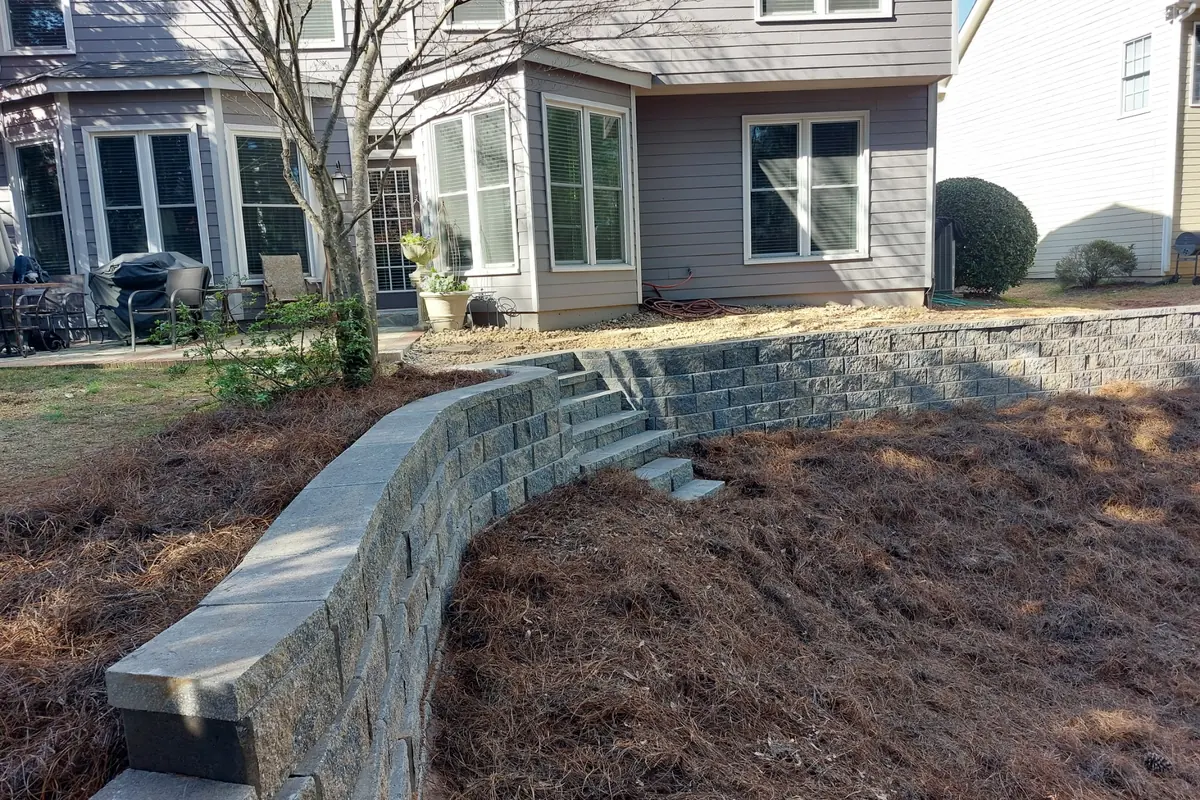
Everything that matters is buried
Two patios can look identical the week they are finished. Three years later one is flat and tight and the other has a dip by the back door, gaps between the pavers and grass coming up through the joints. The difference was never the paver. It was the base.
Georgia red clay is the reason. Clay holds water, and saturated clay moves. Set pavers on a couple of inches of loose sand over unprepared clay and the whole field rides on top of soil that swells when it is wet and shrinks when it is dry. It will settle, and it will settle unevenly.
So we excavate to real depth, put down fabric where the subgrade is soft, and build up compacted graded aggregate in lifts instead of one thick dump. Each lift gets run with a plate compactor. That base is what your patio is actually standing on, and it is the part nobody sees and nobody can inspect later.
Retaining walls: drainage or failure
A retaining wall is holding back wet dirt. Water in that soil creates pressure against the back of the wall, and a block wall will not win that fight over time. Every wall we build gets clean drainage stone behind it, a perforated pipe at the base, and an outlet where the water can actually leave. That is the difference between a wall that stands and a wall that leans out at the middle and starts stair-stepping apart at the joints.
The base course is the other half. It goes below grade, on compacted stone, and it gets leveled block by block. Every course above it inherits whatever error is in that first one. Taller walls get geogrid tied back into the soil so the wall and the hill behind it act as one mass instead of two.
Height matters legally, not just structurally. Once a wall gets past about four feet, most Georgia counties, Cobb included, want a permit and an engineered design. In Cobb the office is Community Development. We check the local requirement before we dig rather than after a neighbor calls it in. If your job needs an engineer, we will tell you that on the first visit.
What we build
- Paver patios, sitting areas and outdoor kitchens on a compacted aggregate base
- Walkways, front approaches and steps that match the house instead of fighting it
- Segmental block retaining walls with drainage stone, pipe and geogrid where the height calls for it
- Timber and boulder walls where the look fits the property
- Terraced walls that turn an unmowable bank into two level, usable spaces
- Seating walls, columns and steps built into the patio, not added onto it
- Concrete work, driveway aprons and pads
- Repair and rebuild of failing walls and settled patios other people installed
Details that decide how it ages
Slope is deliberate. A patio should be pitched away from the house so water sheds instead of pooling at the door. Edge restraint holds the outside course from creeping outward under load, and without it the field spreads and the joints open. Polymeric sand goes in the joints and gets set properly so it locks up instead of washing out in the first hard Georgia thunderstorm.
Where the patio meets the yard, we look at what happens to the water we just redirected. A patio is an impermeable surface. Add several hundred square feet of it and that runoff has to go somewhere. On a lot of properties the right answer is a drain line tied in during the same dig, while the machine is already there and the ground is already open.
Why the same company should do the dirt work
Hardscape sits on grading and drainage, and grading and drainage are what we do. Because it is one company, the base, the wall, the drain line and the sod that goes back down afterward are all on one scope and one price. Nobody is blaming the other trade when a corner settles.
Under the Pavers, In Order
-
Layout, permits and excavation
We mark the shape, call for utility locates, confirm what the county requires for wall height, then dig to full depth instead of skimming the sod off.
-
Base, drainage and the first course
Fabric where the clay is soft, aggregate compacted in lifts, drainage stone and pipe behind any wall, and a base course leveled block by block before anything stacks on it.
-
Lay, lock and clean up
Pavers set to pattern, cuts made tight at the edges, edge restraint installed, joints filled and set, then the site graded back, seeded or sodded, and blown clean.
Hardscape FAQs
Do I need a permit for a retaining wall in Georgia?
It depends on the height and the county. Once a wall gets past about four feet, most Georgia counties, Cobb included, want a permit and an engineered design. We confirm the requirement for your address before we dig, and we tell you on the first visit if your job needs an engineer.
Why is my existing wall leaning or coming apart?
Almost always water and base. If there is no drainage stone and no pipe behind the block, wet soil pushes on the wall until it bulges at the middle and the joints stair-step apart. If the base course was set on dirt instead of compacted stone, it settles and every course above it follows. Both are fixable, but they are a rebuild, not a patch.
Pavers or poured concrete?
Poured concrete is usually cheaper up front and it cracks eventually. Pavers cost more and they flex with the ground instead of cracking, and a damaged one can be lifted and replaced without a saw and a patch that never matches. On clay that moves, pavers age better. We do both and will tell you which fits your budget and your site.
Will grass and weeds grow up through the joints?
Some seed will always blow in and try. Polymeric sand installed and set correctly makes the joints tight enough that very little takes hold, and what does pulls out easily. Loose sand joints are what turn into a weed problem two summers later.
How long does a patio or wall take?
It depends on size, access for the machine, and how much dirt has to move. Hunter will give you a realistic window when he prices the job, and if weather pushes it he will call you rather than leaving you guessing. Digging in saturated Georgia clay makes a mess and a weak base, so rain does move us.
Can you fix the drainage while you are already digging?
Yes, and it is usually the cheapest time to do it. The machine is on site and the ground is already open. A new patio adds runoff that has to go somewhere, so tying in a drain line during the same job costs a fraction of coming back to open it up later.
Get a Price On Your Patio or Wall
Send us the address and what you are picturing. Hunter will walk the grade, check the drainage and give you a number. No charge to look.
Licensed & Insured · 10+ Years of Trusted Service · Serving All of Georgia